
Middle East Hotel Pipeline Hits Record 177,000 Rooms, Saudi Arabia Leads
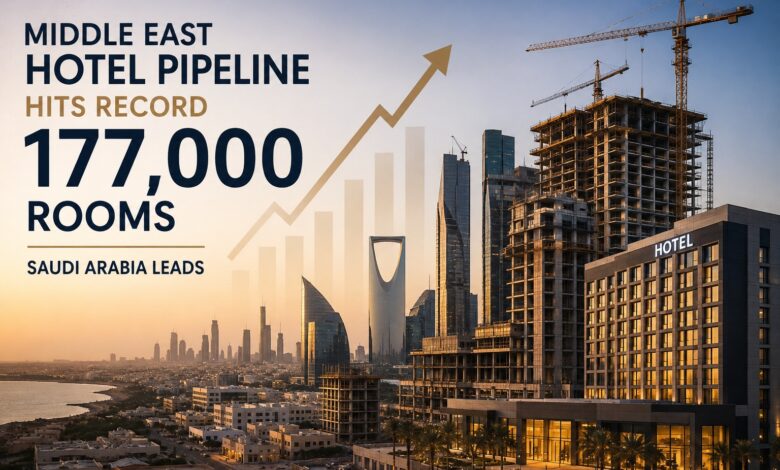
The Middle East hospitality market entered the second quarter of 2026 with a record development pipeline of 717 projects totalling 177,110 rooms, a 12 percent increase from the same point a year earlier, with Saudi Arabia’s giga-project portfolio identified as the primary driver of that growth.
Saudi Arabia’s giga-projects, spanning NEOM, Red Sea Global, Diriyah and Amaala, have begun delivering their first hospitality assets in 2026, with NEOM’s Sindalah island resort, the Shura Island development within Red Sea Global, and early Amaala facilities among the properties now adding rooms to operating inventory rather than sitting purely in the pipeline. That shift, from announced projects to actual operating rooms, is the more significant story behind the headline figure, since a pipeline number alone says little about how much of it will genuinely open on schedule.
Saudi Arabia raised its 2030 tourism visitor target to 150 million after surpassing the original 100 million target in 2025, a performance that has directly validated the scale of the Kingdom’s tourism infrastructure investment and reinforced the case for continued giga-project spending even as some individual projects, notably NEOM, face reported cost and scope revisions.
Separate data from STR, CoStar Group’s hospitality analytics division, put the wider Middle East pipeline at over 231,000 rooms as of June 2026, with Kostas Nikolaidis, STR’s associate account director for the Middle East and Africa, noting that continuous investment in hotel pipeline is required to realise the ambitious economic diversification plans embedded in national strategies such as the PIF Strategy 2026-2030. He pointed specifically to greenfield Saudi giga-projects, Red Sea, AlUla and Diriyah among them, as embedded directly in these masterplans, designed to generate demand beyond traditional hubs like Makkah and reposition the Kingdom as a global tourism destination in its own right, not solely a religious tourism market.
The comparison with the UAE is instructive. The report notes the UAE’s hospitality market is navigating a more challenging environment in the first half of 2026, a contrast that underscores how much of the region’s current pipeline growth is specifically Saudi-driven rather than reflecting broader Gulf-wide momentum. For a publication built around Saudi hospitality specifically, that divergence is the real headline, the Kingdom isn’t simply keeping pace with regional peers, it’s now the primary engine of Middle East hotel development growth.
What the raw pipeline figures obscure, and what’s worth tracking issue by issue, is delivery risk. A 12 percent year-on-year pipeline increase is a planning and investment signal, not a guarantee of rooms actually opening on the announced timelines. Saudi Arabia’s giga-projects in particular carry construction and logistical complexity well beyond a standard urban hotel build, remote locations, new infrastructure requirements, and in NEOM’s case, publicly reported scope reductions. Distinguishing between pipeline announcements and confirmed, funded, under-construction rooms will matter increasingly as the Kingdom’s 2030 targets approach.